Davidson River's strongest radioactive response to date: How Standard Uranium prioritised Its drill targets.
Standard Uranium has completed its largest drill program to date at the Davidson River Project in Saskatchewan's southwest Athabasca Basin, with 6,734 metres drilled across 12 diamond drill holes along the Warrior, Bronco and Thunderbird conductive and structural corridors.
Three holes returned multiple intervals of anomalous radioactivity above 300 counts per second (cps), totalling 5.0 metres of composite anomalous radioactivity. Most notably, DR-26-040 at Bronco returned a maximum handheld spectrometer reading of 1,650 cps - the strongest radioactive response recorded at Davidson River to date.
Behind those drilling results was a critical exploration decision:
How to narrow Davidson River’s broad conductive corridors into specific, prioritised drill targets.
The decision: where to drill first
The exploration challenge was not simply to identify broad conductive trends. Standard Uranium needed to move from those corridors to specific structural positions worth testing. The project objectives were to vector along the known conductors, interpret structural architecture and identify potential zones of alteration.
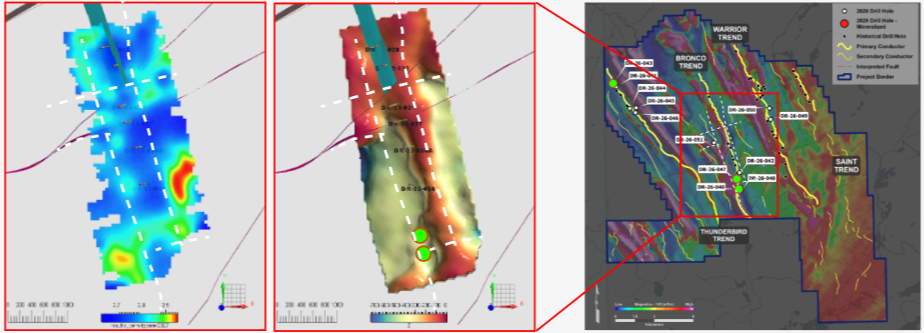
ExoSphere added another layer of subsurface context to that decision. Fleet Space combined 3D Ambient Noise Tomography (ANT), Horizontal-to-Vertical Spectral Ratio (HVSR) and ground gravity to characterise velocity, density and structural architecture across the Warrior, Bronco and Thunderbird corridors. Standard Uranium integrated those outputs with its existing drilling logs, historical geological interpretation, modelled surfaces and airborne geophysics. Targets were then selected and prioritised iteratively with Fleet SpaceAt Bronco, the structural interpretation shows how subsurface velocity architecture relates to previously interpreted faults. In the visual below, DR-26-040 is highlighted at an interpreted southern fault intersection, while the project-wide drilling map shows the three holes that returned anomalous radioactivity. The point is not that ExoSphere independently selected any one collar; it is that the ExoSphere interpretation helped constrain the structural positions Standard Uranium evaluated alongside its broader exploration dataset.
The drilling results
The anomalous radioactivity was concentrated in three holes across the Bronco and Thunderbird corridors. All three sit within corridors covered by the ExoSphere Seismic-led campaign.
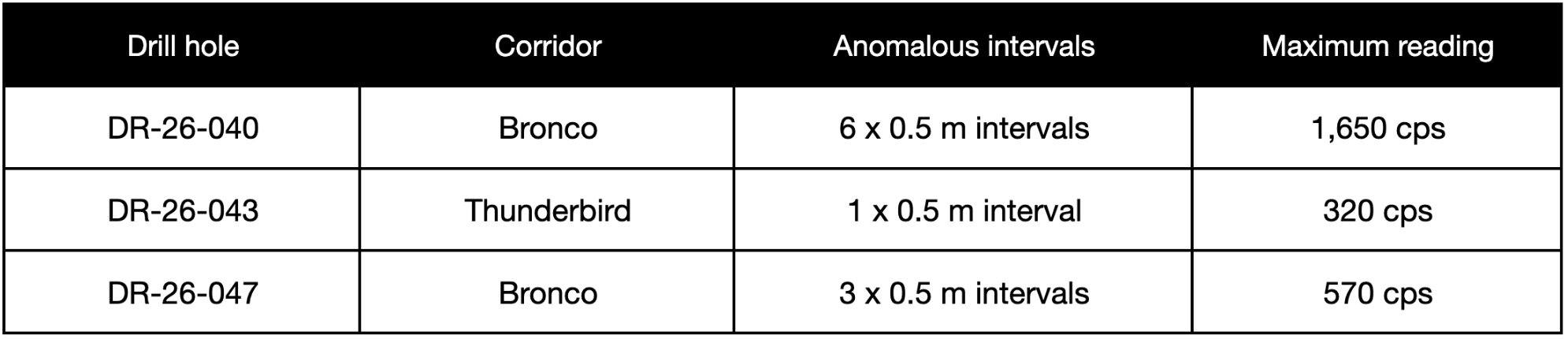
DR-26-040 was the standout, reaching 1,650 cps. More importantly for the exploration decision, the drilling returned radioactivity together with significant structure and hydrothermal alteration in the same broader target areas the team had prioritised for testing.
What changed for Standard Uranium
Standard Uranium reported graphitic faults and shear zones, breccias, cataclasites, fault gouge, strong fracturing and local structural features relevant to its search for basement-hosted uranium mineralisation.
Multiple intervals also showed moderate to strong hydrothermal alteration, including sericite and dravitic clays, hematite and quartz-carbonate veining. Initial PIMA analysis confirmed dravitic-clay alteration in DR-26-040 at Bronco.
The new intersections also more than doubled the known width of both the Bronco and Thunderbird structural corridors to greater than 300 metres across strike, materially expanding the scale of the geological picture the team can carry into follow-up targeting.
Why this matters for exploration teams
Mineral exploration is rarely short of anomalies. The harder decision is determining which anomalies represent the structures worth drilling, and where finite drilling capital should be deployed first.
Electromagnetics, gravity and magnetics each reveal different physical properties of the subsurface. Seismic adds another critical dimension: the geometry and velocity structure of the rocks themselves. That can help exploration teams map faults, shear zones, geological contacts and changes associated with structural disruption or alteration at depth, and understand how those features relate to anomalies already identified in other datasets.At Davidson River, that is the role the ExoSphere played. It did not replace Standard Uranium’s existing EM, gravity, geological or drilling information, and it did not independently discover uranium. Instead, it added an independent seismic view of the subsurface that could be integrated with those datasets to better constrain structural architecture and support a more informed decision about which positions within the broader conductive corridors should be prioritised for drilling.
The outcome is the important part: those prioritised target areas went on to deliver Davidson River’s strongest radioactive response to date.
What comes next
Drill core from the program has been sampled for whole-rock multi-element geochemical analysis, while samples from anomalously radioactive zones have been submitted for U3O8 assay. Handheld spectrometer readings are preliminary and are not uranium grades.
Standard Uranium says those results will be integrated with detailed drill logging and geophysical datasets to prioritise follow-up targets for future drilling. More than 60 kilometres of conductive strike remain untested at Davidson River, giving the team a much larger next-decision space to rank and refine
Standard Uranium, October 1, 2026 - 2026 Davidson River drilling results. View source
Standard Uranium, June 2, 2026 - drill program and ExoSphere targeting context. View source
Planning your next drill campaign?
Bring us your priority targets and existing exploration datasets. We'll assess whether seismic-led subsurface intelligence could help refine your targets and prioritise your next drill locations.
Book a target review →
You might also like
.png)
.png)