








Every geologist considers a miss. The budget rarely does. The first holes set a program's trajectory, without decision rules that survive the first assays, an early miss reads as a verdict.
The challenge
The target is set.
Drilling needs to test if it’s real.
A$200–500K+ per hole.
Multiple viable geometries.
A market watching the first assays.
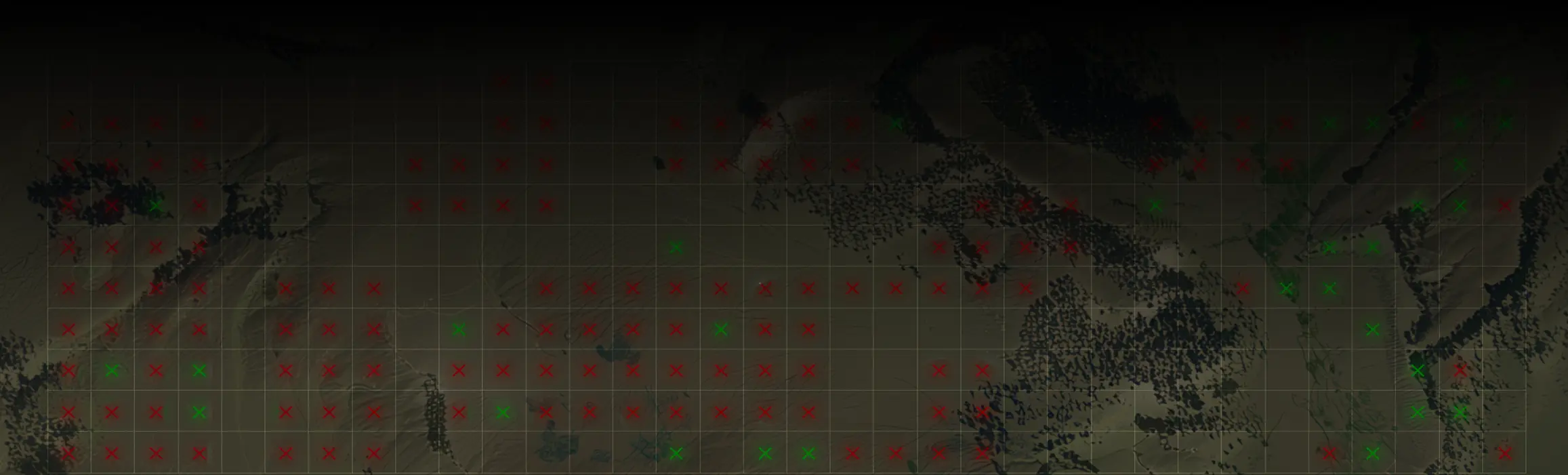
Most first-phase programs commit their opening holes to the hottest anomaly, where the most data agrees. It's a defensible target. But the strongest chargeability on the property can be a barren pyrite halo, not the core, and a coincident anomaly still can't tell competing geometries apart.
The full test usually exists at the planning table. Then reality closes in: budget is approved for fewer holes than the test needs, the season is short, the first hole comes back quiet, and the next collar becomes a step-out guess under a share price that's already moving.
Drilling the wrong place is expensive. Walking away from a discovery after an early miss costs more. Both come from the same gap: a test design with no decision rules binding it.
The drilling status quo
If the first hole is barren, the program feels its way forward until confidence or budget runs out, whichever comes first.
A definitive test
A miss should redirect the
program. Not end it.
A definitive test is settled before the rig arrives: how many holes constitute a complete test, which geometries they cover, and what result at each step confirms, redirects, or concludes?
With those rules set upfront, a first-hole miss is a planned branch of the program. Without them, the first disappointment gets adjudicated by the market instead of the geology, and the conclusion you take to the board is a guess.
The solution
Seismic purpose-built for drill-ready resolution.
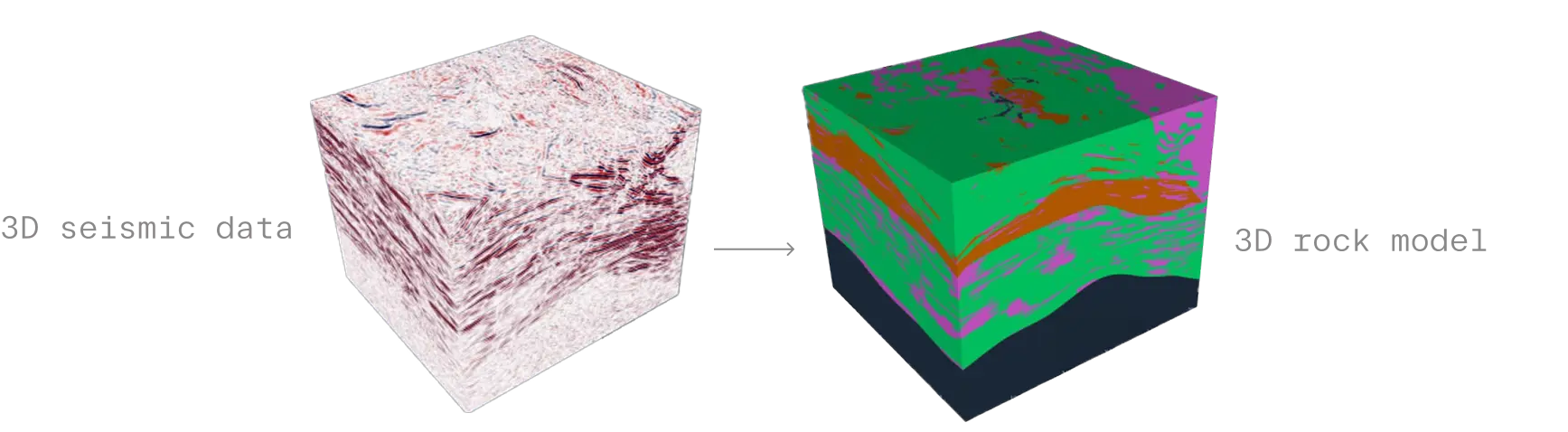
High-resolution imaging of the target's 3D geometry, resulting in a model with quantified uncertainty. The complete test is designed and agreed before drilling starts, not improvised after the first assays.
The coincident isn't the test. The whole target is.
Stacked anomalies make a defensible first collar, not a complete test. A designed program covers the geometries the coincident high cannot discriminate, so an early negative result narrows the search instead of ending it.
Structural geometry at drill ready resolution
High-resolution active seismic images the structure of what's about to be drilled, at depths where other methods lose resolution. The model is validated at drill-collar scale before the rig spins, not by the rig itself.
Every hole makes the model better.
A miss is only wasted if nothing is learned from it. Each hole updates the exploration model interpretation and tightens the next collar, so the program vectors form a constrained model rather than a step-out guess.
Conclude. Positive or negative
The program reaches a real conclusion inthe fewest holes and dollars. A discovery you scale into, or a walk-away you can defend, with every meaningful target tested and the remaining uncertainty named. Either answer protects your momentum and credibility.
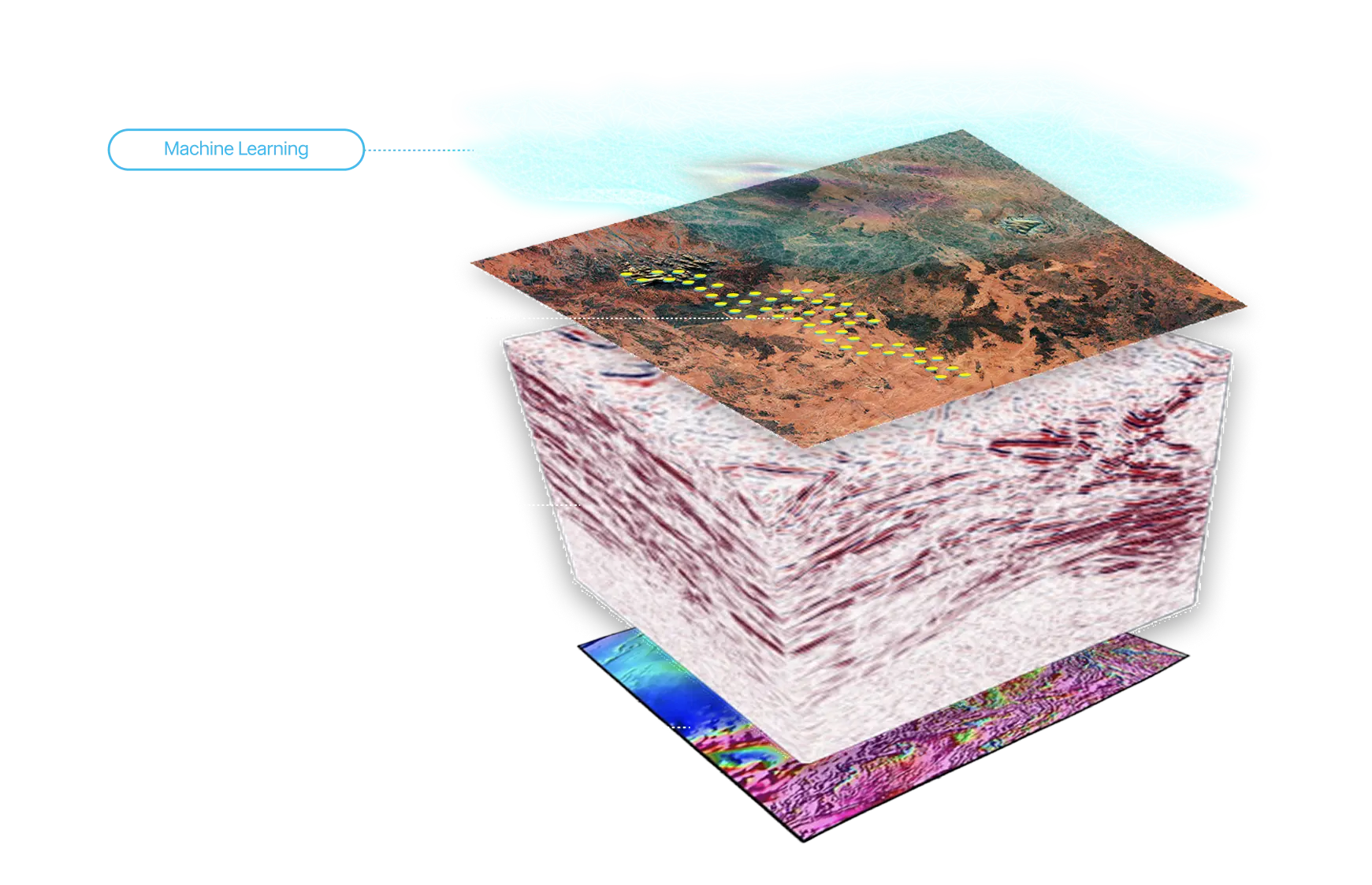
Machine learning
A model that learns
drill by drill.
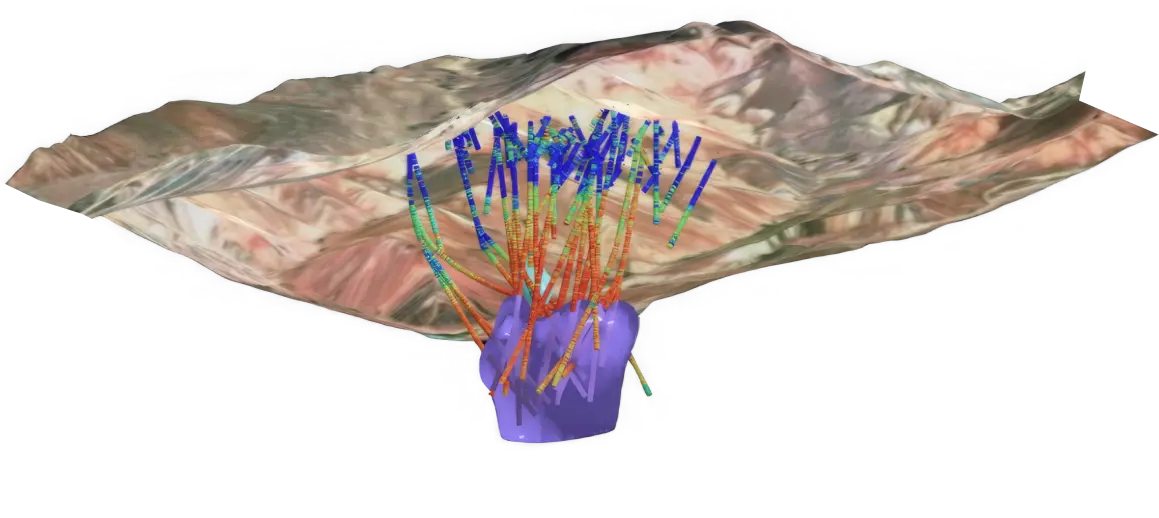
Every hole updates the ML model. The geological interpretation is refined, target confidence recalibrates, and every updated ranking traces back to the holes that changed it, so the geologist can interrogate why the model evolved.
Where a program is unsuccessful, the learnings carry into the next one, reducing the likelihood of the same miss twice. Where it succeeds, the emphasis shifts to confirming a target with as few holes as possible, because the uncertainty that drilling was meant to resolve no longer exists.
The solution
Fleet works differently.
The only seismic team
dedicated to mineral exploration.
A seismic workflow built for hard rock
The difference in hard-rock seismic isn't the processing engine, it's the workflow around it. ML-assisted steps like first-break picking, tuned for mineral systems, and interpretation by hard-rock geoscientists, not seismologists retooled from oil and gas.
Drill-collar resolution. Not survey-scale approximation.
High-resolution 3D active seismic resolves the target at the scale the rig demands: deposit-scale 3D geometry, precise enough to place collars and orientations. ANT, potential-field and electrical methods narrow the search. Active seismic settles the geometry.
Seismic is never read on its own.
A strong seismic reflection can be a real target, or just barren pyrite or magnetite. On its own, seismic can't always tell the difference. Fleet checks every reflection against your existing data and drilling before it's called a target, so no single dataset, including ours, makes the decision alone.
The complete test, designed before the rig moves.
A 3D model with quantified uncertainty lets the whole program be structured upfront: every viable geometry covered, decision rules agreed at each hole. The first hole targets the highest-confidence part of the model. The rest are pre-planned to eliminate what it can't.
ML constrained by geology, not applied over it
Targets trace back to physical structure in the seismic volume, not patterns in training data. The model is trained on your drillhole database, supervised on your own ground truth, and every ranking is traceable and defensible to a board.
A model that learns as you drill.
Every hole feeds back. The structural interpretation refines, the next collar tightens, the program vectors toward a definitive conclusion instead of feeling its way forward until the budget runs out.
Customer impact
Ground truth for
in-the-field decisions
Challenge
High-grade copper-gold porphyry at depth. MT defined a broad conductive target but could not resolve fault architecture or intrusive geometry. No data-driven basis for prioritising the next drill campaign.
Solution
Meteor by Fleet workflow: ANT integrated with existing MT data, Comet mineralogy applied to differentiate ore from alteration, ML grade model trained on Cu assays and validated against three blind drill holes.
Impact
70% reduction in prospective search volume. New drill targets ranked by grade and confidence generated across a system still open NNW, SE, and at depth.

Challenge
Blind epithermal gold beneath 200m of post-mineralisation cover in remote jungle terrain. Surface methods and IP lacked resolution to define the fault controls. No structural basis for committing drill capital.
Solution
High-resolution 2D active seismic across five lines totalling 26.4 km, integrated with existing drillhole assays, geological models, and structural interpretations.
Impact
Two high-priority drill targets identified within weeks of delivery. Fault imaging extended to 3.5 km depth. Immediate drilling enabled. Promising early results.

Challenge
Gold project. Primary targets 600m below surface. Too many competing geological narratives. No model capable of resolving which targets warranted capital.
Solution
ANT survey integrated with legacy drill data, assays and gravity. ML ranking applied across the full search space.
Impact
Two targets confirmed drill-ready. Third target walked away. Saving estimated $3M in misallocated drilling spend.

Challenge
District-scale copper tenement. Drilling budget approved. Structural confidence too low to defend target sequencing.
Solution
ANT survey across 45 km² combined with existing magnetics and geology to build the first 3D structural framework. Integrated model delivered 48 hours after field acquisition.
Impact
Search space reduced from 11 zones to 3 priority corridors. Phase 1 drilling committed within 6 weeks.
Assess you project
Integrated 3D
seismic intelligence
One data-informed test.
Every hole productive.
A conclusion you can defend.
- Image the target's structure at Drill-ready resolution, constrained against data you already own.
- Design the complete test: every viable geometry covered, decision rules agreed at each hole
- Drill and feed each result back into the model, tighten the next collar.
- Reach a genuine conclusion, positive or negative, in the fewest drill metres.
Assess your project.

Explore with Fleet
Seismic built for modern exploration
“When one innovative industry joins another, magic happens.”
-Flavia Tata Nardini,
Chief Executive Officer & Co-founder