Sharper Drill Targeting at Valeriano
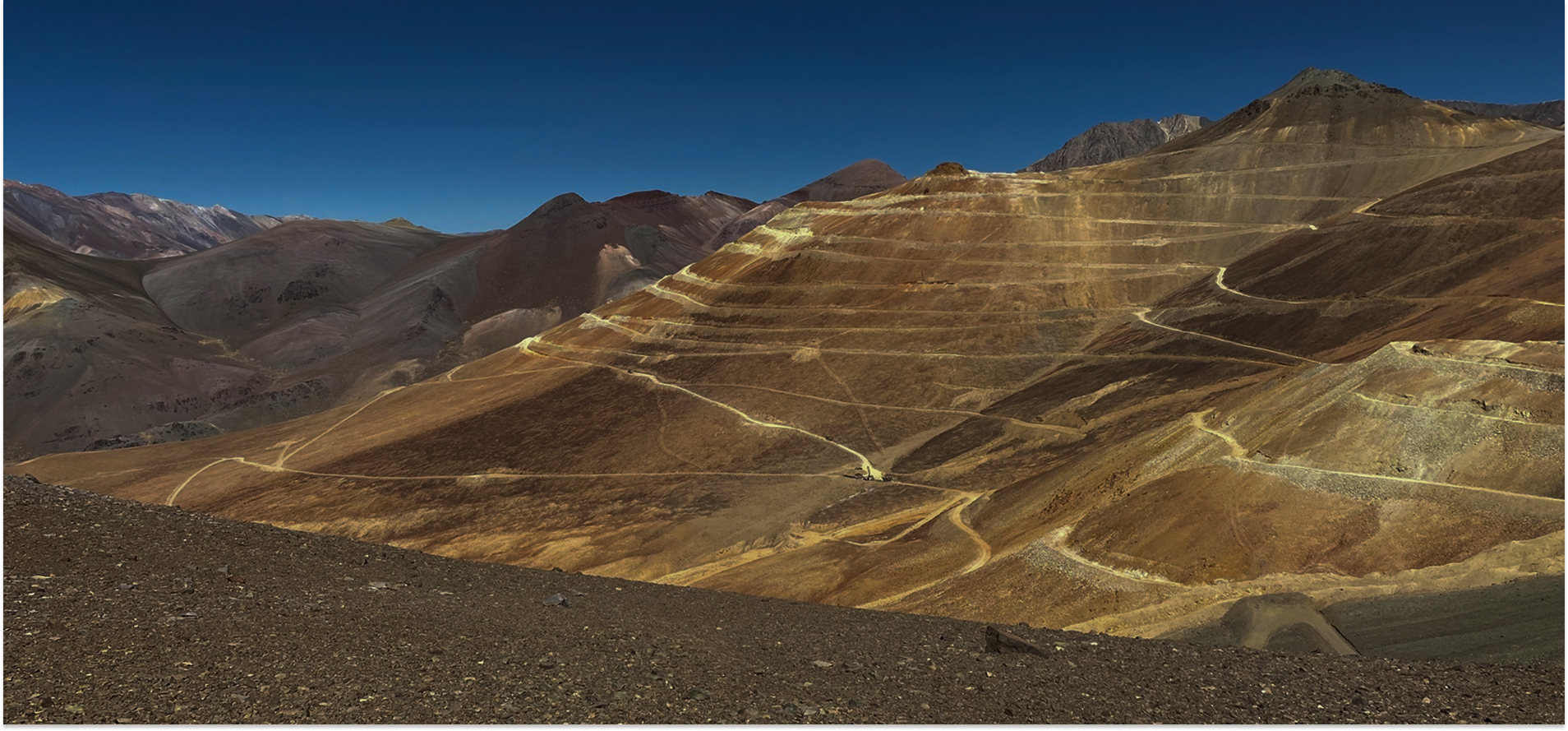
Integrating ANT + MT + Mineralogy + ML to define the architecture of a Copper-Gold Porphyry System.
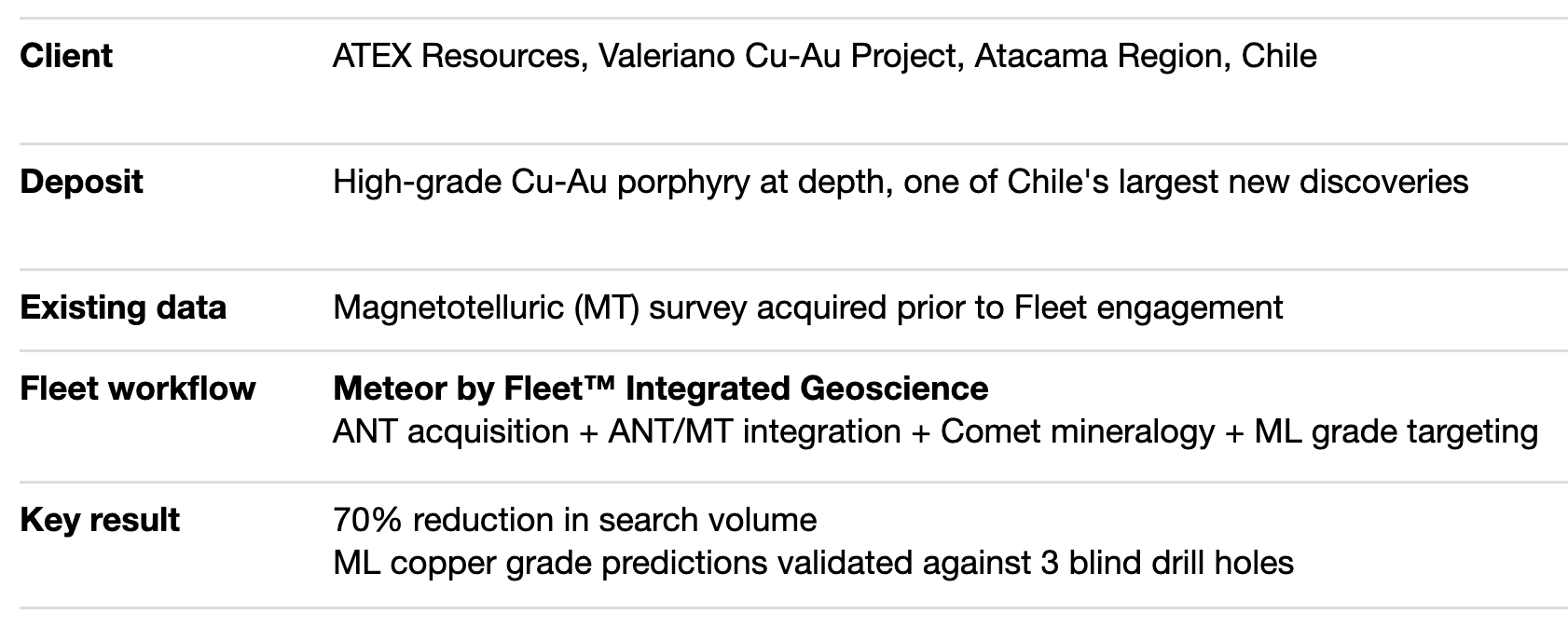
■ Client
ATEX Resources is a Canadian copper-gold explorer with its flagship project at Valeriano in Chile's Atacama Region.
Valeriano is one of the most significant copper-gold discoveries in Chile in over a decade. ATEX has delineated an Indicated Resource of 475 Mt at 0.88% CuEq and an Inferred Resource of 1,511 Mt at 0.75% CuEq, a deposit still open along strike and at depth, with high-grade intercepts continuing to set project records through Phase V drilling.
The deposit is a telescoped copper-gold porphyry, with chalcopyrite and bornite-bearing potassic alteration at depth, overprinted by advanced argillic and phyllic zones higher in the system. Sitting atop the main porphyry body is a high-grade hydrothermal breccia horizon, referred to as the B2B zone, that represents the highest-grade domain in ATEX's programme. Drill holes extend to depths exceeding 2,000 metres, demonstrating a system that is large, deep, and structurally complex, but with classic porphyry-style hydrothermal alteration zonation. The resource remains open along strike and at depth.
To sharpen drill targeting and accelerate resource definition, ATEX engaged Fleet to run a Meteor workflow across the Valeriano system: integrating Fleet's Ambient Noise Tomography (ANT) with the existing MT dataset, building a machine-learning grade prediction model anchored to available drilling, and validating predictions against three held-out drill holes before new capital was committed.
■ The Local Geology
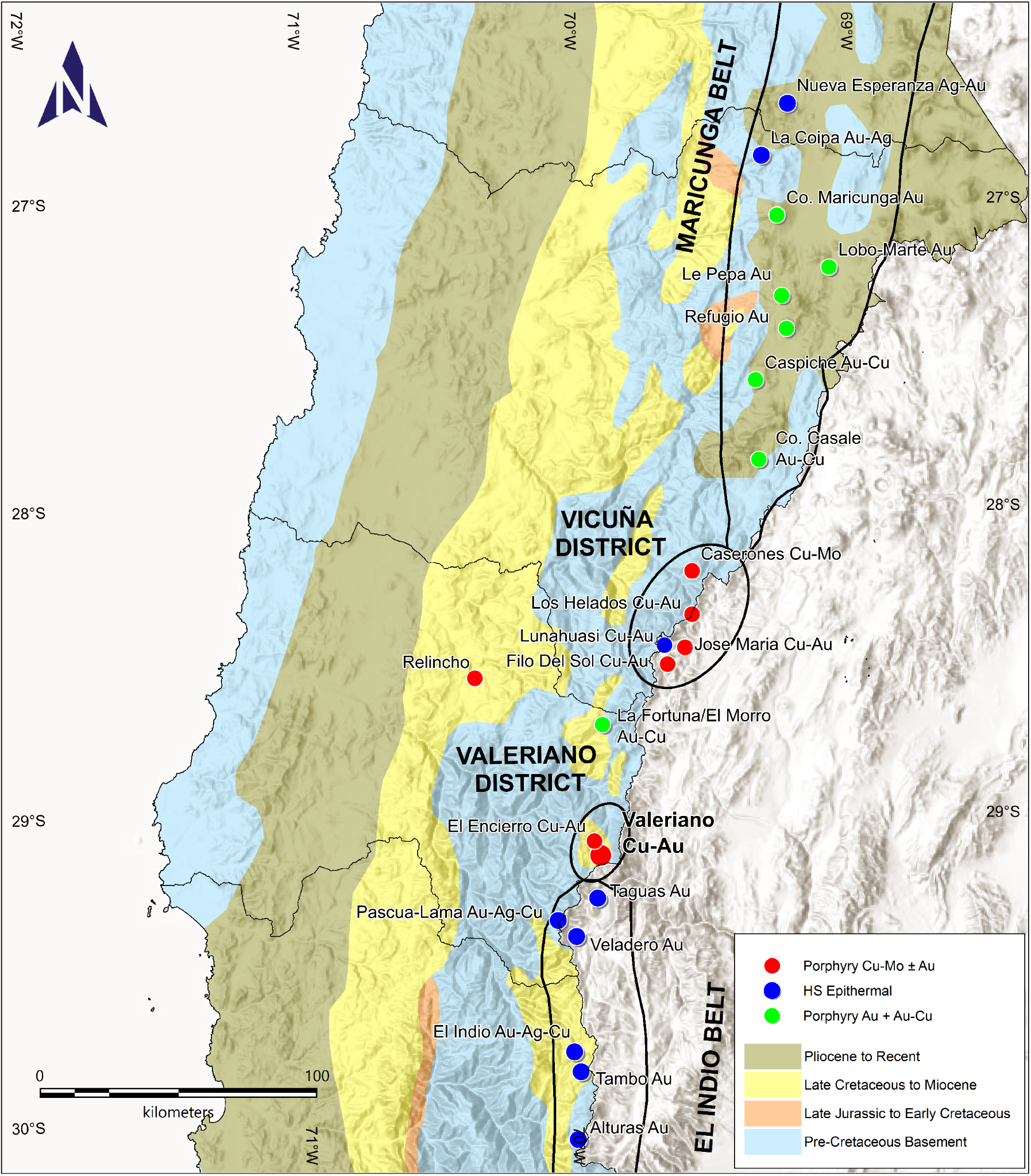
Valeriano is located within the roughly north-south trending Miocene to early Pliocene metallogenic belt that stretches along the eastern Chilean and western Argentinian border, continuing north into Peru. The project sits within this belt between the northern limit of the El Indio Belt and the southern margin of the Maricunga Belt, a corridor ATEX refers to as the "Link Belt" (Figure 1). Both the El Indio and Maricunga Belts host numerous significant copper and gold deposits and have seen extensive exploration since the early 1900s. The Link Belt has seen increasing exploration activity since the early 2000s, leading to several significant new discoveries.
The Valeriano project, along with the adjacent El Encierro project, occurs within a north-south trending graben formed approximately 20 Ma ago during a period of major tectonism along the western edge of the continent. This structural event caused significant uplift of a Permo-Triassic package of rhyolitic to dacitic volcanic rocks, underlain by a granitic Paleozoic batholith (Figure 2). That package was later intruded by a suite of granodioritic to dacitic porphyries during an extensive period of plutonism and volcanism through the late Oligocene to late Miocene. Subsequent erosion of the upper section has produced the present-day landscape, the most prominent feature of which is an 18-kilometre north-south trending ridge rising more than 500 metres above the valley floors to the east and west. Both Valeriano and El Encierro are situated along this ridge.
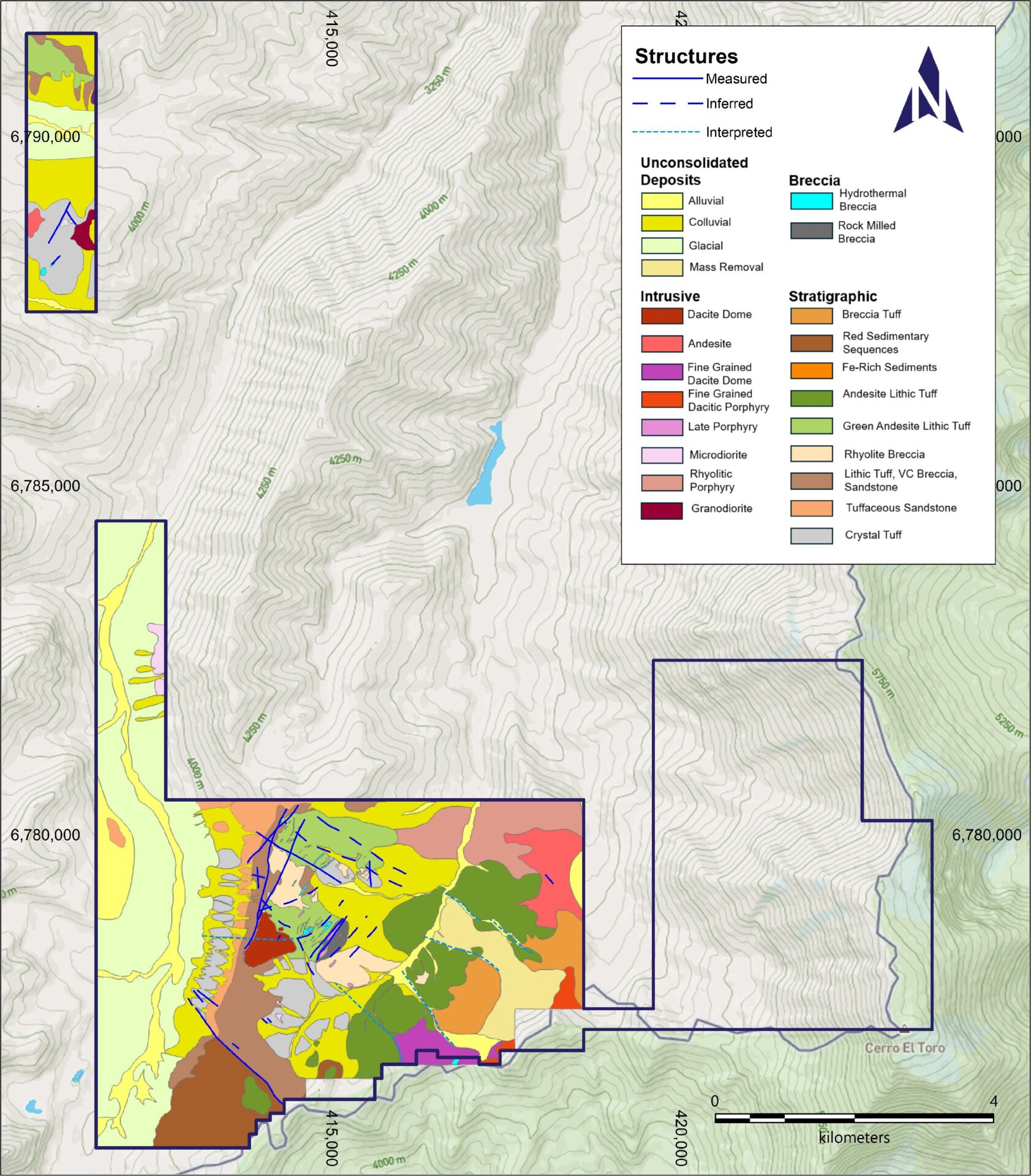
A large alteration zone extends more than 10 kilometres along the ridge, from the southern boundary of the Valeriano project to the northern extent of El Encierro. Three major phases of intrusion have been defined by ATEX geologists from drill core, documenting the temporal relationships between the porphyry units. As each phase was emplaced, attendant hydrothermal fluids mineralised the host rocks. Later fluid phases remobilised and overprinted earlier mineralisation as the system evolved. Collectively, the porphyry units and surrounding mineralised wall rock contain the most significant concentration of copper-gold mineralisation within the project.
■ The Challenge
MT defined a large conductive target. Geometry at depth remained unresolved.
The Valeriano porphyry system is structurally complex. ATEX had a known resource, an existing magnetotelluric (MT) dataset, and a growing drill programme. What’s often lacking in complex systems is a clear exploration model at depth, and a data-driven basis for prioritising where to drill next.
MT surveys had defined deep conductive volumes consistent with the broader alteration footprint. The problem is inherent to the method. MT smooths resistivity responses, and at depth, multiple structural interpretations remain consistent with the same inversion.
Existing surveys could not reliably distinguish between:
- The primary porphyry source geometry and its depth plunge
- Alteration overprinting that widens and blurs the conductivity signal
- Intrusive contacts and fault architecture that concentrate high-grade mineralisation
Existing drill data and ATEX's geological model described the known system, but could not determine how far the system extended past drill data or predict the continuation of the high-grade B2B breccia horizon beyond the current footprint.
At drill depths often exceeding 2,000 meters, the cost of drilling is significant. Committing collar surveys without rigorous data-driven criteria meant testing competing interpretations with the rig.
Each mis-targeted hole at Valeriano depth is not just a sunk cost. It is a missed vector on a system that is still open.
The critical question ATEX needed answered before committing additional capital: how extensive is the high-grade core of this system, and which parts of the unexplored volume are most likely to contain it.
■ The Objective
Constrain the structural and alteration architecture of the Valeriano porphyry system at depth with seismic resolution that other geophysical methods cannot offer
- Define the geometry and lateral extent of the B2B breccia horizon in 3D
- Identify whether the system extends meaningfully north, south, and east of current drilling
- Decouple high-grade mineralisation signals from known structural corridors to identify potential standalone targets
- Reduce prospective search volume before committing additional drilling capital
- Generate a ranked, geologically justified drill target list for the next program phase
■ The Solution
Meteor: structural constraint first, then ML targeting anchored to ground truth
[ 1 ] Ambient Noise Tomography
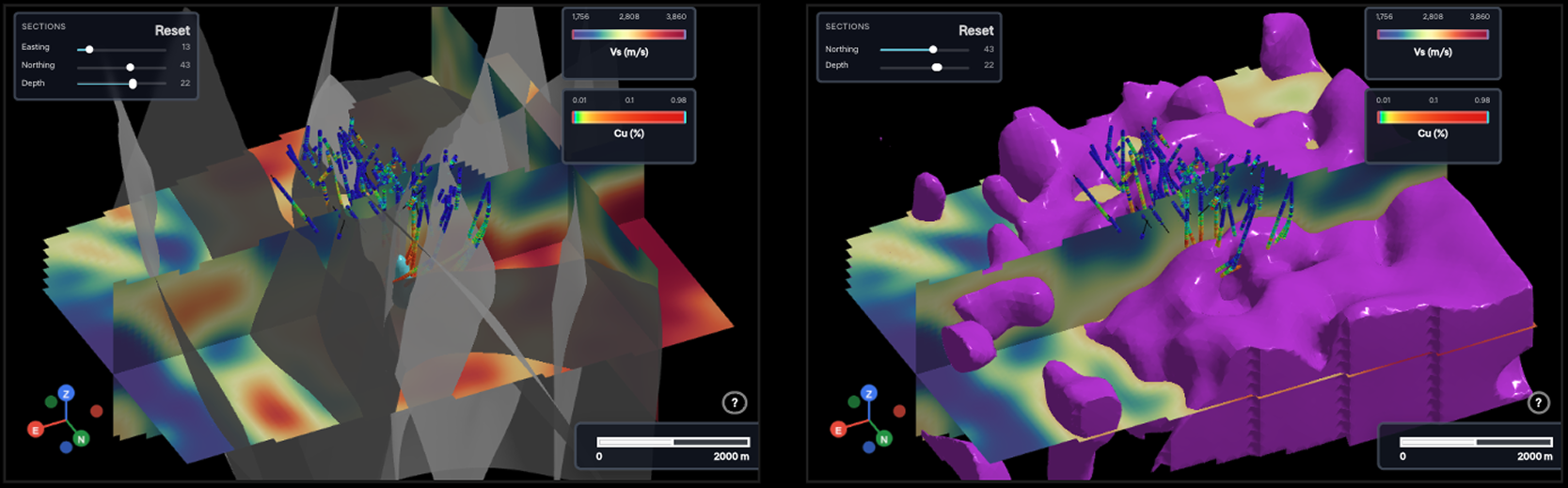
Fleet deployed a 200-Geode passive seismic array across the Valeriano project area in December 2025, recording ambient seismic noise for approximately three weeks. The array covered 28.3 km² at 400 meter station spacing, producing a 3D shear-wave velocity model to 1,900m depth at 80 meter resolution. ANT uses ambient seismic noise to build a 3D shear-wave velocity (Vs) model, a physical property that responds independently of MT's resistivity signal and is sensitive to rock stiffness, density, fracturing, and hydrothermal alteration.
At Valeriano, the ANT velocity model resolved the structural skeleton the MT inversion lacked: fault architecture, intrusive geometry, and domain boundaries that define where the high-grade system is mechanically focused. The B2B breccia zone, ATEX's highest-grade domain, sitting atop the main porphyry, produces a distinctive velocity signature that can be tracked in 3D without drilling.
[ 2 ] Integrated ANT + MT model, 70% reduction in search volume
The ANT seismic dataset was integrated with ATEX's existing MT data, which Fleet reprocessed to improve resolution and consistency. The seismic velocity model resolved the structural skeleton that MT alone lacked: fault architecture, intrusive geometry, and the domain boundaries that define where the high-grade system is mechanically focused. MT mapped the electrical conductivity of the alteration and sulphide network. Together, they constrained both structure and mineralisation simultaneously.
- ANT: 51,918 prospective blocks (21.8M m³) based on a velocity threshold (>2,899 m/s) associated with altered and fractured rock
- MT: 50,020 prospective blocks (6.9M m³), based on a conductivity threshold (<200 ohm·m) consistent with sulphide and clay mineralisation
- ANT+MT: 14,969 blocks (2.7M m³) The intersection blocks satisfying both criteria simultaneously, reduced the prospective volume
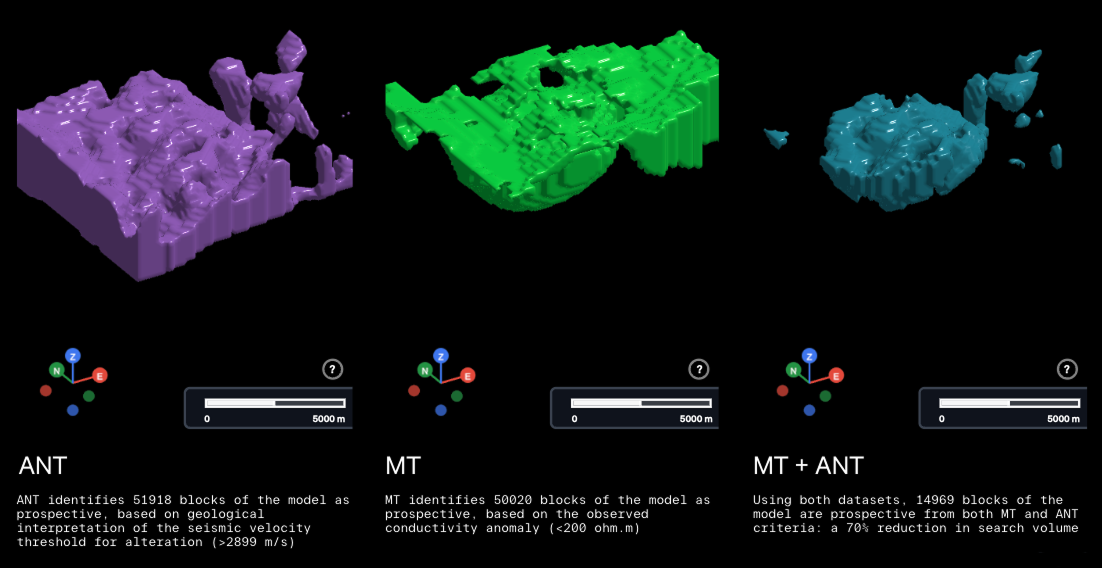
70% reduction in search volume combining two datasets that were already in hand.
[ 3 ] Comet: linking assay data to mineralogy
Drill targeting requires a conceptual understanding of the ore system — not just where conductivity or velocity anomalies exist, but what they represent mineralogically. Fleet's Comet module bridges geophysics and geochemistry, using drill hole assay data to define the mineralogical zonation of the system and differentiate ore from alteration.
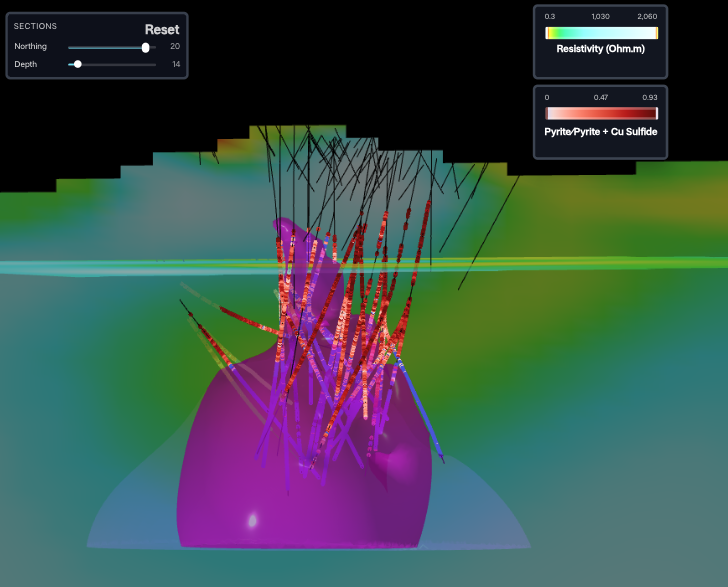
- Sulfide Ratio [Py / (Py + Cu-Sulfide)]: identifies the copper centre. A low ratio indicates a high concentration of copper sulfides (chalcopyrite/bornite) relative to waste pyrite, marking the most productive part of the mineralised system.
- Silicate Ratio [Mica / K-Feldspar]: maps alteration zonation. A low ratio (K-Feldspar dominant) marks the high-temperature potassic core; a high ratio (Mica/Sericite dominant) indicates the cooler, more acidic phyllic halo that typically surrounds or overprints the ore.
Together these ratios produce a 3D interpretation of ore vs. alteration that constrains where within the ANT + MT prospective volume the highest-grade material is most likely to sit, providing the conceptual targeting framework the ML model is anchored to.
Review the full Comet™ modal mineralogy work at Valeriano HERE
[ 4 ] ML grade prediction, validated against blind drill holes
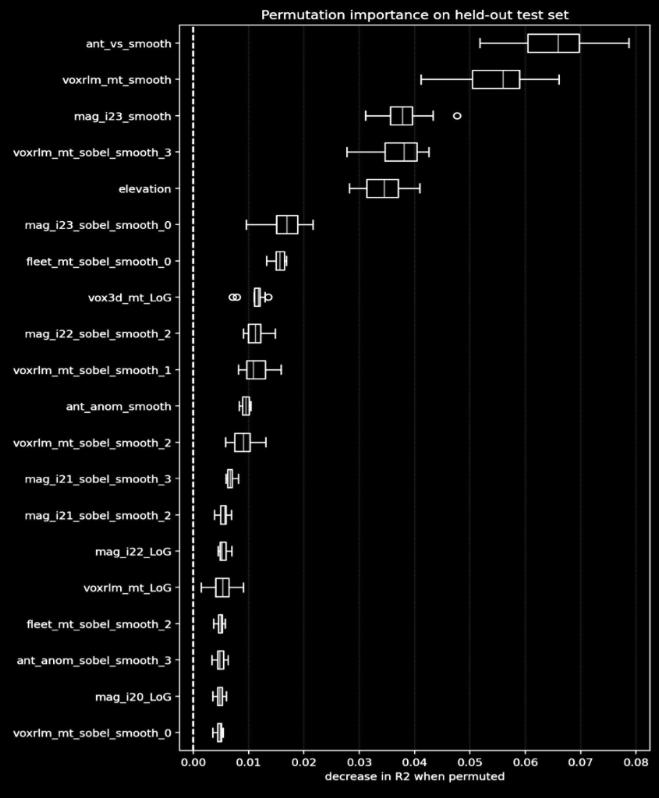
An ML targeting model was trained on the integrated 3D geophysics alongside available Cu assay data from Valeriano drilling.
The model outputs:
- 3D Cu grade predictions across the full model volume. The model volume is divided into a regular 3D grid of voxels, each representing a discrete block of subsurface at a defined spatial resolution. Every voxel carries the geophysical values from joint inversion at that location (resistivity, velocity, and derived parameters), a predicted Cu grade, and a confidence interval expressed as 25th and 75th percentile bounds. A narrow interval indicates the model is confident at that location; a wide interval indicates the geophysical signal is ambiguous or data coverage is sparse. Drill targets are prioritised where predicted grade is high and the confidence interval is tight.
- Ranked drill hole proposals, optimised to maximise both the probability of high-grade intercept and spatial coverage across the predicted volume.
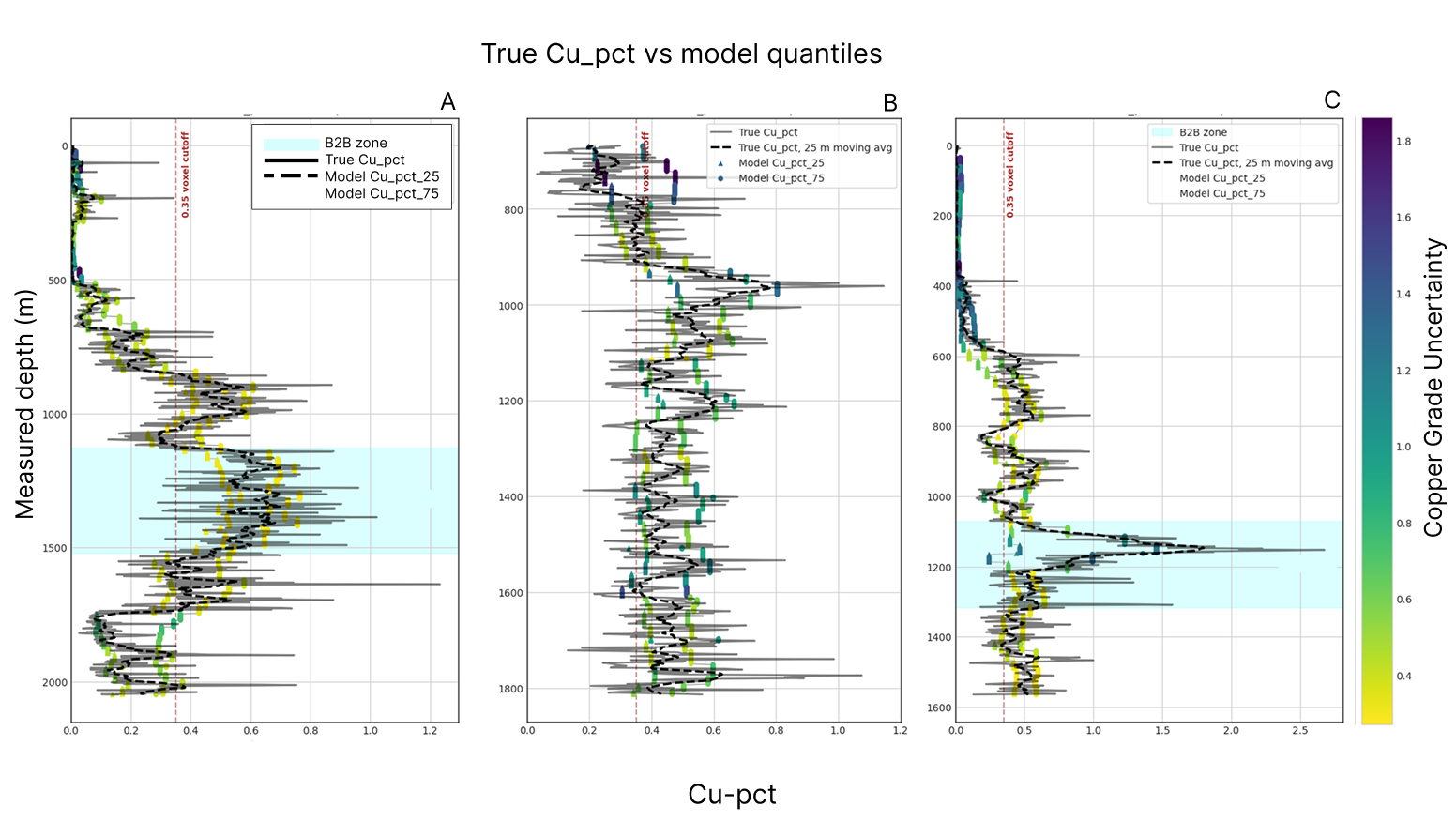
Three test drill holes were withheld from training and used as a blind validation test. The model had not seen these intercepts. Predicted Cu grades were compared directly against true assay values along each hole before any new drilling decisions were made.
■ The Results
Blind test confirmed. The model predicts what the drill finds.
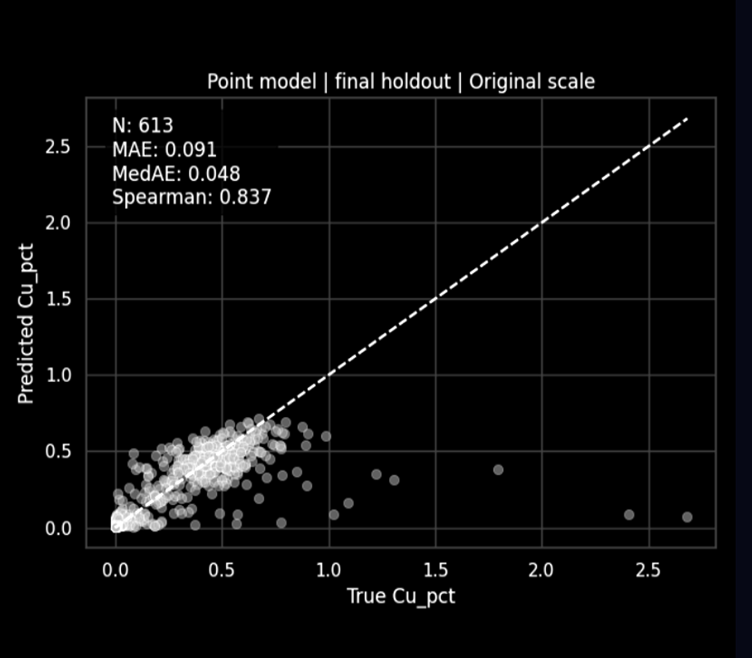
Across all three validation holes, the ML model demonstrated strong agreement with actual Cu grades from the Valeriano drill program:
- True Cu grades consistently fell within the predicted 25th–75th percentile confidence range including through the high-grade B2B zone intercepts
- Spearman rank correlation of 0.84 between predicted and actual grades on held-out drill data
- Model uncertainty tracked geological complexity, lower confidence where the system was structurally heterogeneous, higher where ANT and MT signals converged
- 25m moving-average smoothing of actual Cu grades aligned closely with model voxel predictions, confirming the model operates at the right spatial scale for Valeriano's drilling resolution
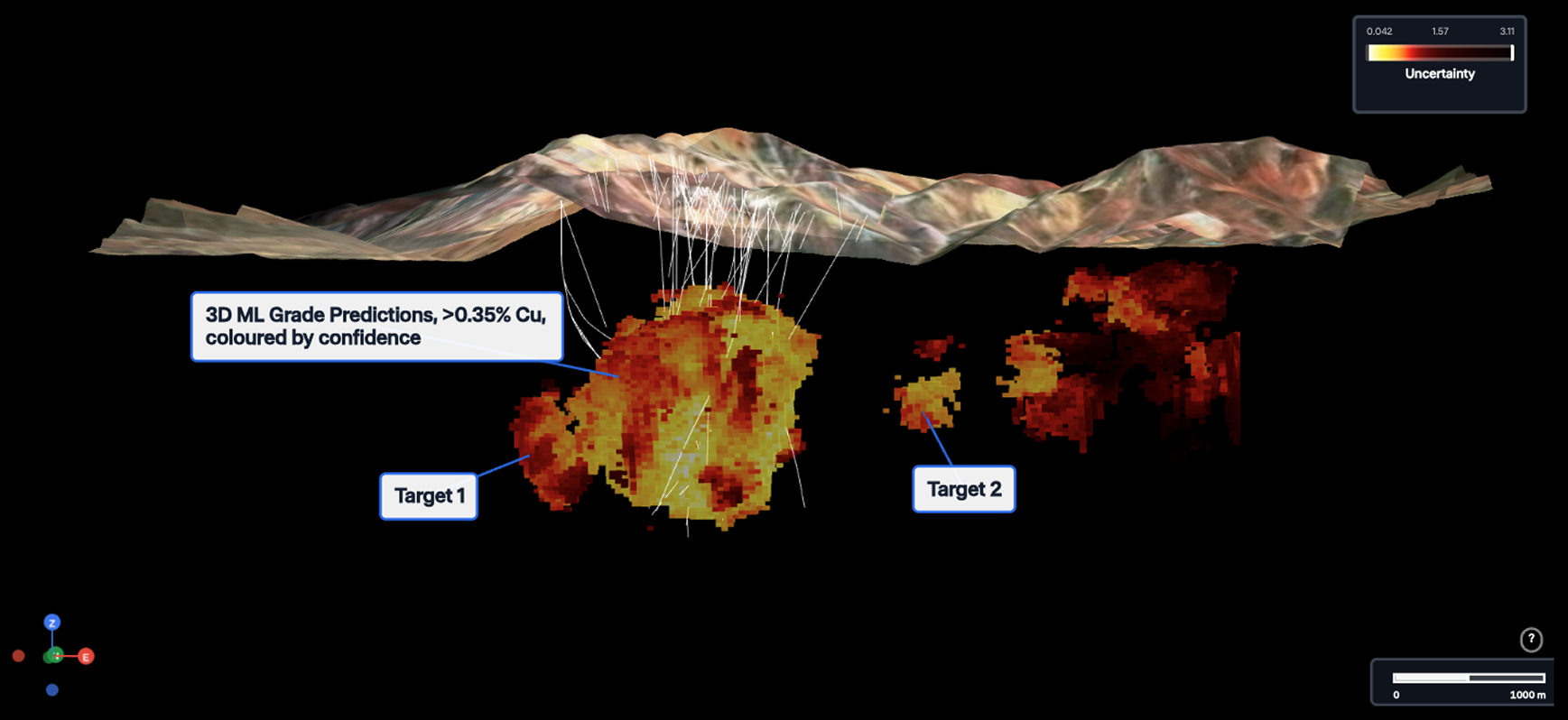
The blind test is the critical gate. These holes were not used to tune the model. They validate the structural framework underpinning the predictions and confirm that the Meteor workflow is reliable for forward targeting at Valeriano, where the system remains open NNW and SE, and at depth.
■ The Results
What Meteor delivered for the Valeriano program
Structural clarity
ANT resolved fault architecture, intrusive geometry, and the B2B breccia horizon in 3D, the framework MT alone could not provide at depth.
Reduced search volume
70% reduction in search space by combining ANT and MT. Two large independent envelopes collapsed to one constrained, drillable target.
Quantified targeting
ML model produces Cu grade predictions with confidence bounds across the full 3D volume — decision-grade, not directional.
Validated before capital
Three blind holes confirmed model accuracy before new drilling was committed. Reducing risk of mis-targeted holes and increased costs.
Adaptive model
As new Valeriano assays return, the model retrains and target rankings update. Each hole improves the confidence on the next.
■ Key Takeaways
What this means for Valeriano's next phase
- The MT survey was not wasted. ANT constrained it, converting a broad resistivity envelope into a structurally defined target. The value was already latent in ATEX's existing dataset.
- The full porphyry system is imageable without drilling. The ANT model resolves distinct velocity signatures across multiple system components, including the B2B breccia zone, the alteration envelope, and the broader structural architecture. This provides a 3D framework for orienting directional holes to maximise intercept probability across ATEX's highest-grade domain.
- ML predictions are validated, not assumed. Three blind holes confirm the model works at Valeriano. That is the standard of evidence required before using predictions to
direct capital. - The system is still open, with ranked targets ready to drill. Meteor identified multiple novel targets, both as extensions of the known high-grade trend and in areas beyond the main discovery. The high-grade porphyry trend remains open to the NNW, SE, and at depth. These targets are already ranked and proposed. No new geophysical acquisition is required before the next drill campaign
■ The Big Picture
Valeriano is the right project to demonstrate what Meteor can do.
Valeriano is one of the largest high-grade porphyry discoveries in Chile in a decade. The resource has been built rapidly, three years of porphyry drilling to define what comparable discoveries took decades to establish.
The next phase of value creation at Valeriano is not just more drilling, it is smarter drilling. The system is large enough that the question is no longer whether mineralisation exists, but where the highest-grade material is, how it is geometrically controlled, and how to intercept it efficiently at depth.
That is the question Meteor is built to answer. The Valeriano case demonstrates it works, with ATEX's own data, validated against ATEX's own drill holes.
.png)
You might also like
.png)