Antarctica: Advancing Off-World Exploration Science For Moon & Mars Missions

Propulsion systems and orbital mechanics have made humanity’s future beyond Earth possible. To make the future a reality depends on our ability to understand, locate, and responsibly utilise the resources that exist beneath the surface of other worlds. At Fleet Space, our mission is to build next-gen subsurface exploration systems to accelerate discovery of critical resources needed for humanity to sustainably thrive on Earth and beyond. This year, that mission led us to Antarctica, one of the most extreme and scientifically valuable analogue environments on Earth.

Antarctica’s polar desert, buried ice systems, and operational constraints closely mirror the challenges that future missions will encounter on the Moon and Mars. Resources such as high-grade water ice are rarely visible at the surface. They are hidden at depth, often beneath complex geological structures. Discovery therefore demands wide-scale 3D subsurface imaging before any meaningful drilling can begin. On Earth, drilling without sufficient data wastes capital and time. On Mars or the Moon, drilling blind risks mission failure. Future exploration architectures must be lower-cost, more agile, and capable of covering larger areas with precision. The problem is not merely reaching other worlds; it is knowing where to act once we arrive.

“To build permanent research stations on the Moon and Mars, we must first master how to understand and use local resources responsibly and intelligently,” said Flavia Tata Nardini, Co-Founder and CEO of Fleet Space. “Bringing together institutions, disciplines, and expertise from across the global space ecosystem to advance the science and refine these technologies in lunar and Martian analogue environments will maximise humanity’s opportunity to establish a sustainable presence on other worlds in the years ahead.”
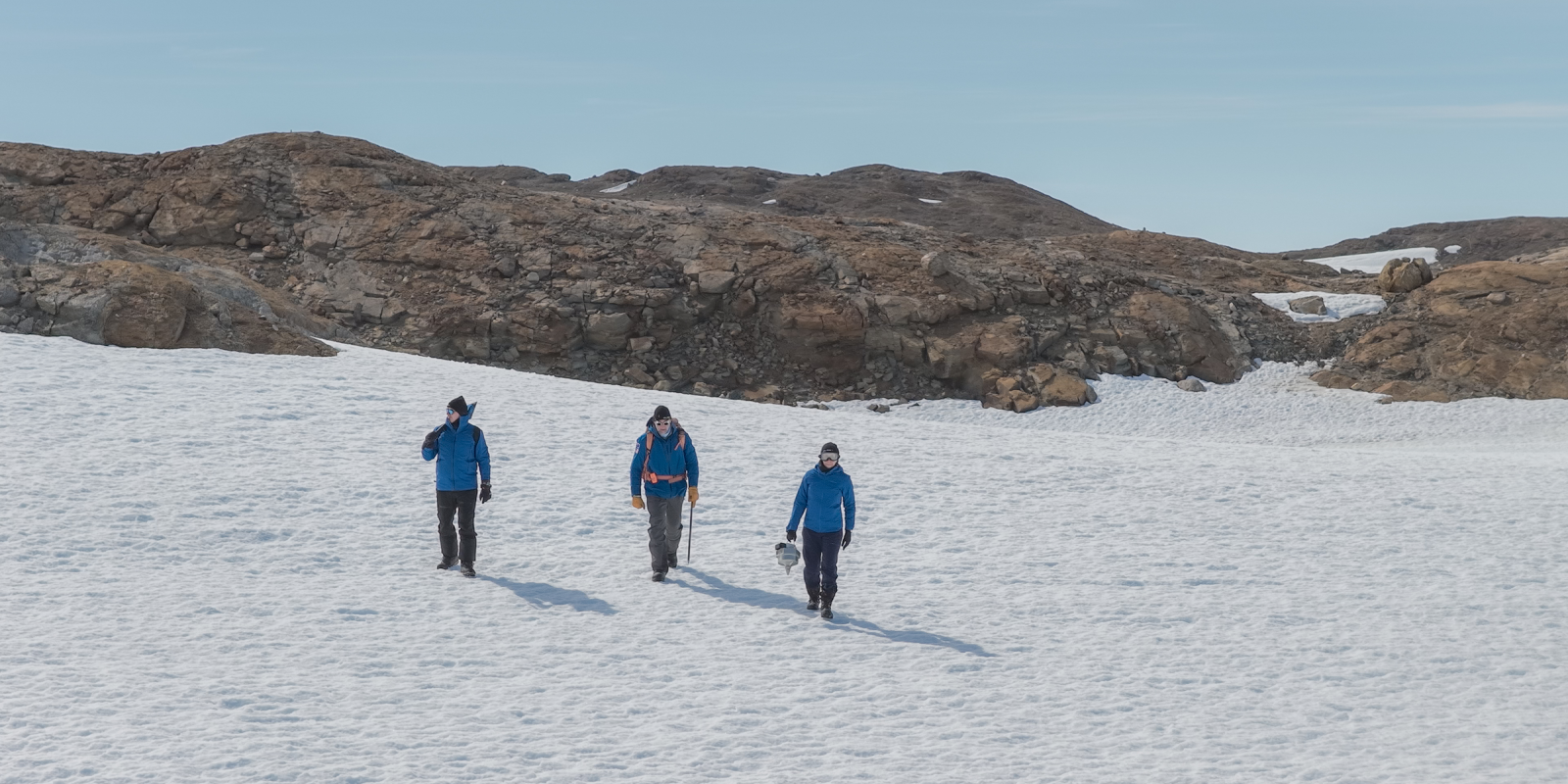
Led by world-renowned explorer Tim Jarvis, Fleet Space convened a global team of scientists and engineers on expedition to test and refine off-world exploration technologies that support in-situ resource utilisation (ISRU) in Martian and lunar analogue environments. The expedition brought together leading scientists and engineers, such as Brian Glass of NASA Ames Research Centre (ARC), Carter Fortuin of Honeybee Robotics a Blue Origin Company, Cody Paige of Columbia University, and Dale Andersen of the SETI Institute. Together, the team deployed Fleet Space’s off-world seismic technologies alongside the TRIDENT-like drill, a regolith and ice drill destined for the Moon, and distributed acoustic sensing (DAS) technology from Terra15, to develop a methodology where high-resolution subsurface imaging and drilling operate as an integrated, data-driven system.

Fleet Space’s ultra-efficient, portable seismic sensing technologies, adapted from the company’s ExoSphere platform and engineered for extreme conditions, were deployed to enhance the scientific understanding of Antarctica’s geology with real-time 3D models of buried ice and subsurface structures. By pairing real-time seismic sensing with off-world drilling systems that act as seismic sources, the team advanced the science to de-risk drilling decisions on the Moon and Mars with real-time subsurface intelligence.
This approach enables mission planners to rapidly identify high-value drilling targets, de-risk infrastructure development, and increase the probability of finding high-grade ice, subsurface structures and other critical resources earlier in the mission cycle. For future off-world missions, such capabilities will be essential in reducing launch mass, conserving energy, and ensuring that each operation is informed by precise geological insight. On Firefly Aerospace’s Blue Ghost Mission 2, Fleet Space will deploy its lunar variant of its ExoSphere technology - SPIDER - to search for water ice and advance the scientific understanding of the Moon’s subsurface.

The Antarctic expedition builds on Fleet Space’s broader program of analogue research across the globe. In collaboration with the USGS and NASA, Fleet Space deployed its seismic sensors at the Mars analogue Rock Glacier in Wyoming to refine subsurface ice detection methodologies. With the MIT Media Lab Space Exploration Initiative, the company pioneered real-time 3D imaging of lava tubes in the Canary Islands - structures analogous to those observed on the Moon and in the Tharsis region of Mars.
Fleet Space has also tested its seismic sensing technologies alongside NASA Ames Research Center’s TRIDENT-like drill at the Roverscape Testing Facility and conducted advanced subsurface imaging at the Haughton Impact Crater in the Arctic Circle, one of the most Mars-like environments on Earth. Each of these expeditions contributes to a cumulative body of research designed to refine operational doctrine for sustainable off-world exploration.

For Matt Pearson, Co-Founder and Chief Exploration Officer of Fleet Space, the objective is operational precision. “Future missions demand rapid, scalable and highly portable technologies that deliver high-resolution, data-driven decision-making in real time. By combining seismic sensing with intelligent drilling methodologies, we enable mission designers to justify investment, enhance crew safety, and generate datasets compatible with AI-enabled systems that will guide exploration for decades to come.” The ability to generate AI-ready subsurface datasets in extreme environments represents a foundational capability for the next generation of planetary missions."

Antarctica serves not only as a proving ground, but as a reminder that exploration must evolve from speculative probing to intelligent, data-driven discovery. By integrating wide-area seismic imaging with targeted drilling strategies, Fleet Space is advancing the science of “living off the land” required to unlock subsurface resources efficiently and sustainably on the Moon, Mars, and at home on Earth. As Fleet Space prepares for the deployment of its SPIDER lunar seismic technology to the Moon, the lessons learned in Earth’s most remote environments will directly inform humanity’s next steps into deep space.”
Through sustained collaboration, disciplined science, and the refinement of Agile Geoscience technologies, Fleet Space continues to expand the frontier of subsurface discovery. Antarctica is one chapter in a larger story - one in which the intelligence we build today will shape how humanity explores new worlds tomorrow.
You might also like
.png)
.png)