ExoSphere Supports Fermi Exploration Ltd Intercepts of Uranium-Related Alteration
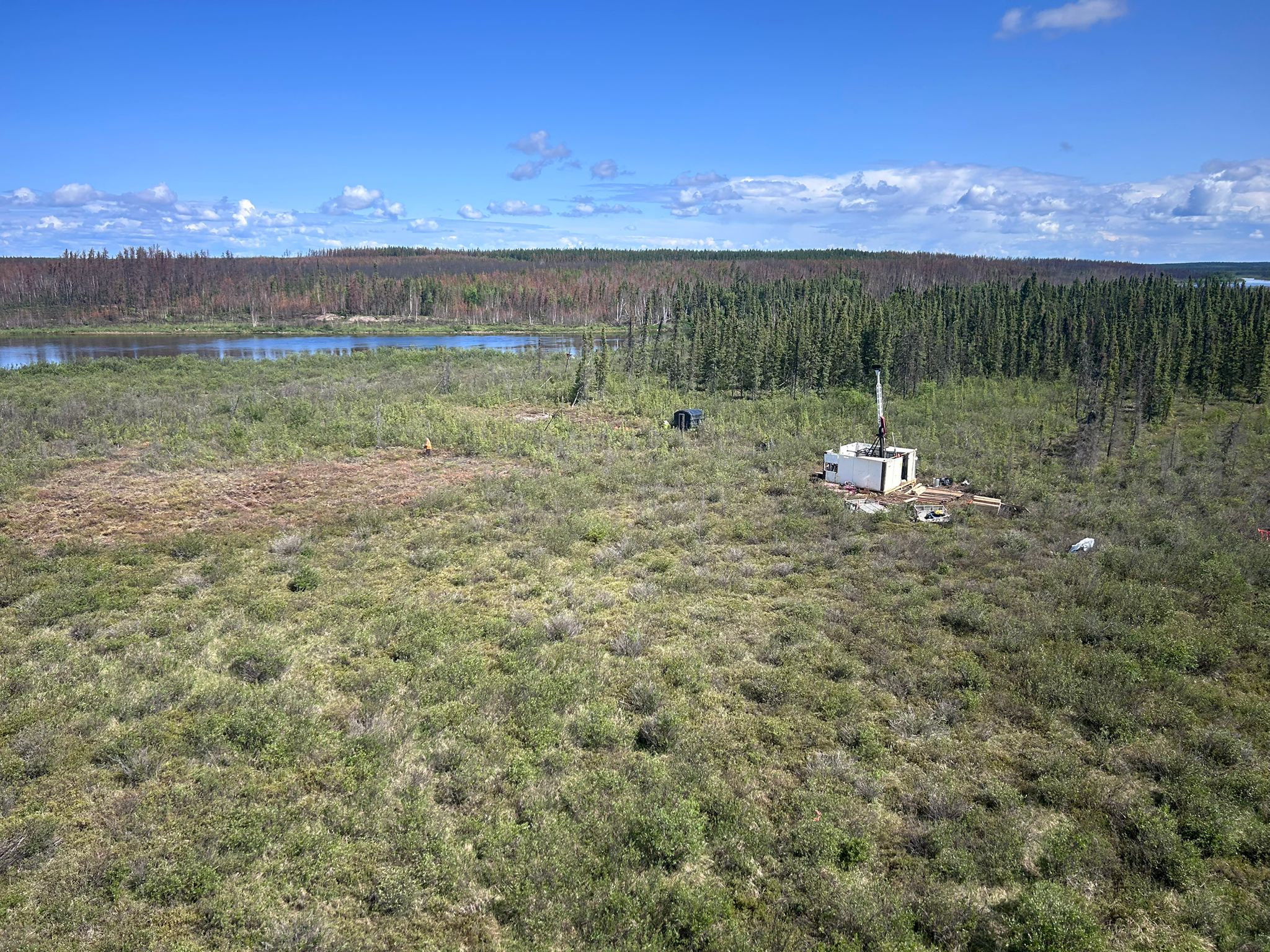
The Perch River Uranium Property, located in Saskatchewan’s Athabasca Basin - home to the world’s highest-grade uranium deposits - is an early-stage, highly prospective exploration project operated by Fermi Exploration Ltd (“Fermi”). The Athabasca Basin is globally recognised for its structurally complex mineralising systems, with uranium mineralisation often hosted within fault structures, but also at the unconformity between cratonic basement, and younger sandstones, giving rise to their name: “unconformity-related uranium deposits”. For such challenging targets, early geochemical vectors and subtle alteration halos are often the first indicators of major discoveries.
In 2025, Fermi deployed Fleet Space Technologies’ ExoSphere platform to image the subsurface structure of the Perch River project, where previous soil and radon sampling had outlined an area of anomalous uranium, nickel, lead isotopes, REEs in soil, alongside locally elevated radon. This sampling was followed in early 2025 by a combined magnetic and gravity survey, which indicated the presence of a potential fault structure, in a structurally complex location.
With traditional line-based geophysics precluded due to the presence of a 100m wide river within the target area, the modularised, highly flexible multiphysics surveys enabled by ExoSphere identified a deep low-velocity zone, termed by Fermi as the “Rapids Fault System”, which was used to refine drill targeting given its potential as a migration pathway for uranium-bearing hydrothermal fluids.
Alteration & Highly Radiogenic Lead Isotopes Intersected
Leveraging ExoSphere’s real-time 3D imaging of the major structural zone, drillhole PR25_04A was designed to test the western extent of the low-velocity zone - intersecting a 100-metre interval (290–390 m downhole depth) containing intense alteration and strongly radiogenic lead isotope signatures consistent with those observed adjacent to uranium mineralisation in the Athabasca Basin.
The intense alteration seen in several intervals between 287.9m to 322.5m downhole in PR25_04A is characterized by pervasive chlorite-hematite alteration and accompanied by intense shearing, fracturing, and brecciation. These features indicate a significant structural and hydrothermal overprint, consistent with deformation and fluid movement along nearby fault zones - a common style of alteration of both mineralised and barren zones in unconformity-related uranium systems.
Additionally, results of up to 242.8 (²⁰⁶Pb/²⁰⁴Pb) and 0.15 (²⁰⁷Pb/²⁰⁶Pb) indicate a strong radiogenic lead signature typically associated with uranium mineralisation within a major fault structure. The anomalous results lie within the ExoSphere-identified low-velocity zone, further validating the Rapids Fault System as the key structural feature governing fluid flow and alteration at the property.
ExoSphere Delineates Structural Complexity in a Tier-One Uranium District
Unconformity-related uranium deposits are historically challenging to detect due to their narrow geometries, deep settings, and irregular alteration systems. Deployment of ExoSphere’s passive seismic surveys revealed: a 400-metre-deep, subvertical low-velocity corridor, coincident with prior soil geochemistry anomalies, and proximal to the Font du Lac Fault. The survey also hinted at the structural complexity of the area, giving further confidence in the model.
This structural architecture provided critical insights for drill targeting, helping to guide hole PR25_04A into the zone now confirmed to host lead isotope results and alteration typical in unconformity-related uranium systems.
“Agile Geoscience is fundamentally reshaping how the world discovers and develops the resources needed for future industries and abundant clean energy,” said Flavia Tata Nardini, CEO and Co-Founder of Fleet Space Technologies. “By delivering real-time, 3D subsurface intelligence in some of the world’s most complex geological environments, ExoSphere is helping to identify critical structures earlier, reduce uncertainty faster, and make more confident decisions with less environmental impact.”
A Strengthened Framework for Continued Exploration
By integrating ExoSphere ANT data with geochemical assays, mineralogy, airborne geophysics and structural observations, Fermi Exploration has increased its confidence in the Rapids Fault System as a high-priority exploration corridor, with further work pending - greatly enhancing future targeting activities in a structurally complex geological environment.
“This approach not only accelerates the path to discovery in tier-one mineral districts like the Athabasca Basin, but also strengthens the resilience of global mineral supply chains at a time when secure access to uranium and other strategic resources is increasingly vital for clean energy systems and future technologies,” added Ms. Tata Nardini.
By accelerating the identification of deep, structural targets, ExoSphere continues to provide explorers in complex geological environments with a rapid, scalable, and environmentally low-impact pathway to reduce uncertainty and improve drill targeting confidence at scale.
Download the Full Fermi Exploration Case Study
You might also like
.png)
.png)